I am a senior at Mercer University majoring in Psychology and Spanish. I have no idea what I want to do after I graduate, but right now I am thinking about going to Physical Therapy School.
Reading Daniel Pink's book has made me a little more comfortable with being "right-brained." I have always seen myself as excelling in creative things, such as dancing, singing, photography, and similar things, and had dreams of going to the Olympics or dancing with the Rockettes. While I had these passions and wanted to pursue them, many of my friends had career ambitions and I would hear them talk all the time about what they wanted to be when they got older. In high school I always heard "I want to be a lawyer" or "I'm going to UGA to major in Biology so I can get into Medical School and be a doctor." I was always very discouraged because I didn't have a similar ambition or goal for my life, that the areas I excelled in were not science or math or other "left-brained" things, but rather creativity and certain "right-brained" activities. At first, I tried to push myself to become more left-brained so that I would be able to have ambitions similar to my friends' so that I could be something successful and make people proud of me. As I began thinking, however, I realized that my right-brain was dominant for a reason, and I had been given the gifts and talents I had been given for a reason, and that I should use them. I chose to pursue the things I was passionate about and had dreams and ambitions for, even though they weren't career ambitions like my friends. That is what I have tried to do ever since, hoping that some day along my path of following my "right-brained" dreams, I will stumble across something that I love that just happens to make me money and give me a career that I will love.
Of course I've had some hesitations by following my dreams that have nothing to do with careers, but I feel as though I would regret not following them in years to come. In A Whole New Mind, Daniel Pink talks about the importance of Meaning, saying that "People who are grateful about specific things in their past, who dwell on the sweet triumphs instead of the bitter disappointments, tend to be more satisfied about the present" (236). In pursuing the things that I am passionate about, I am sure that I will be led in many different directions as a result. There will be times of disappointment and discouragement that lead me in the wrong direction. However, what I will learn from these times will simply be that this is not the path for me. In doing this, hopefully I will be directed onto the right path of what I eventually realize I want to do.No one wants a worker who hates their job. And perhaps if we all pursued what we love and makes us happy, the world as a whole will be a better place filled with people who love and excel at their jobs. Who can complain about that?
One of the six senses that Daniel Pink describes in A Whole New Mind is that of Design. He says "It's no longer sufficient to create a product, a service, an experience, or a lifestyle that's merely functional. Today it's economically crucial and personally rewarding to create something that is also beautiful, whimsical, or emotionally engaging" (65). In my everyday life, I have noticed quite a few things that are either very poorly or very well designed. The things that are average or normal in their design tend to fade into the background, but things that seem to be either very well designed or very poorly designed seem to stick out the most.
One of the first things I think of when I think of poorly designed things is my bedroom. I know that a bedroom might seem weird to include in a discussion about designed products, but it is what sticks out to me most, and I believe it fits into a lot of what Pink talks about, as he discusses the importance of design in public housing. I live the house belonging to the Wesley Foundation, a Christian organization, across the street from campus. The house is very old and when it was remodeled for students to live in, it was designed to have the most amount of rooms possible. Because of this, my room ended up being very small. It seems as though a very unexperienced architect designed our building, because my room is designed very poorly and makes very little sense. As might not be apparent in this picture, the far wall of my room must contain an emergency exit, which was required in every room for the amount of people living in the house. This door cannot be blocked because, again by poor designing the door opens in toward my room and must have room to open. For this reason, my bed must go on the opposite wall. However, the architect that designed the room did not make this wall long enough to fit a regular twin-sized bed. At the foot of the bed is my closet, which was also poorly designed in an awkward triangle shape that cannot fit many clothes at all. Because my closet is here, my bed won't fit flat against the wall and must be pulled about a foot away. This makes a quite noticeable gap between my bed and the wall. So many things about the way my bedroom was designed do not make sense, and I can't help but think that if a better designer had designed this house, everything would work the way it is supposed to. Living in this house has definitely made me think of the importance of design in things like this, and has made me realize even more how much the right brain and left brain have to interact to make something work. To design this house, the designer's right brain would have had to taken over to be able to figure out the best way to arrange all the rooms in the most creative and logical way, while the designer's left brain had to show dominance in measuring walls and making sure that beds, desks, and dressers were able to fit where they are supposed to.
A second product that I have noticed that has been poorly designed are the standard headphones that come with iPods. Their sound quality, as well as their physical design seem far from ideal. The part of the headphone itself that fits inside your ear is poorly designed in that, at least for me, does not ever actually fit in the ear the way it is supposed to. They are constantly falling out and having to be replaced, which is annoying if you are trying to do any other activity at the same time. Another aspect is the sound quality. The sound quality of these generic Apple headphones seems worse than other headphones that you might buy separately at the store. Another thing about these headphones that makes them seem poorly designed is that they are so easily tangled. This might seem like a trivial aspect, but the size, weight, and design of the chord makes it easy for them to tangle themselves and become tied in knots. This really is no serious technical mistake, but can become quite frustrating for some users.
One of the well-designed products I have noticed is the new Deer Park water bottle. I buy Deer Park water all the time because I enjoy the way it tastes, and they have been working recently on trying to make a more efficient bottle. The most obvious physical aspect that you can notice that they have changed is the shape of the bottle. The bottle curves inward toward the center, making a convenient place to hold while you are drinking from or carrying the bottle. There are also many things about the bottle that have been changed in order to be more "green" or to be better for the environment. First, the label has become smaller in order to use less paper. Secondly, the shape of the bottle allows 30% less plastic to be used in the making of it than in other bottles. This makes the bottle much more flexible in order to crush and recycle when you are done drinking from the bottle. The screw-on cap has become smaller, and is now completely recyclable. So many of these things that have been changed about Deer Park water seem small and perhaps insignificant when you first think of them, but all of the plastic and paper that is being saved by making these bottles recyclable will make a huge difference in the environment. Plus, this bottle is very asthetically pleasing and easier to handle and work with, which should make any customer happy. The design of this bottle definitely shows the combined efforts of the right and left brain.
A second very well designed product in my everyday life is my camera. I got a Nikon D80 last Christmas and absolutely love it. Nikon is one of the leading camera companies and has proven to have great quality over and over through the years with their production of many different SLR (Single Lens Reflection) cameras. The ad on Nikon's website claims: "Nikon Digital SLRs combine capability with ease of use to produce incredible digital images. Whether you’re new to digital photography or a seasoned pro looking for the latest in technology, you’ll be able to compare the features, explore the benefits and delve into the details and specs. Turn your ideas into images with a Nikon D-SLR." Capability and ease of use are two of the most important things in any product, especially a camera. Using this camera, I have seen its ability to do so many different creative and useful functions that even an unexperienced photographer can use with ease to make beautiful pictures. The developers and designers of Nikon did an excellent job in combining ease of use with creativity and make this product a great design. Daniel Pink claims in his book that "Good design, now more accessible and affordable than ever, also offers us a chance to bring pleaseure, meaning, and beauty to our lives. But most imoprtant, cultivating a design sensibility can make our small planet a better place for us all" (86). All of these products, good and bad in their design, help to show the importance of design in everything in our lives and how much of a difference design can make in our perception and use of objects all around us.
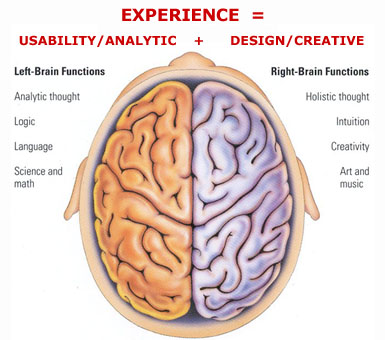
Daniel Pink discusses in the beginning of his book the differences between the left brain and the right brain. In light of our discussions about his book and these differences about the functions of both sides of our brain, I have found some representations of popular beliefs about these:
Here is a popular test that apparently determines if you are right-brained or left-brained. It is said that if you see the dance spinning clockwise, you are right-brained, and if you see her spinning counterclockwise, you are left-brained.
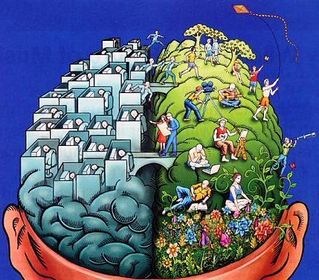
This cartoon shows the right brain and left brain working together. It emphasizes the popular thoughts about both sides of the brain, as well as the importance of their combined efforts that Pink emphasizes is most important.
Here is even a written test to determine whether you are right-brained or left-brained. As we can see, there are many popularly believed ways to determine whether a person is right-brained or left-brained. However, it is important to remember, as Daniel Pink points out in his book, that no one person is completely right-brained or completely left-brained. Even though one side may show more dominance than the other, our lives are an intricate combination of both sides of the brain, and they must work together to do any activity that we try to do on a daily basis. I think this concept is very important to remember in today's world, especially in teaching people who are going to be successful in the future. Those who will succeed the most will be those who realize they need to optimally use both sides of their brain and be equally (or as equal as possible) skilled in activities that both sides of the brain specialize in. And although these tests are fun and and it is exciting to be able to say "I am right-brained" or "I am left-brained," it is important to try to keep developing the other side of the brain so that you can be maximally useful in today's society.
In his book A Whole New Mind, Daniel Pink addresses the concepts of L-directed thinking and R-directed thinking, and more importantly, the increasing importance of the "right brain" in the world ruled by "left-brainers" in the coming years. He says "Ours has been the age of the "knowledge worker," the well-educated manipulator of information and deployer of expertise. But that is changing. Thanks to an array of forces - material abundance that is deepening our nonmaterial yearnings, globalization that is shipping white-collar work overseas, and powerful technologies that are eliminating certain kinds of work altogether - we are entering a new age" (2). I feel as though my schooling so far has adaquately prepared me for the things which are considered "useful" in our day and age - the sciences, maths, and other traits that seem marketable. Throughout high school, most of the "core" classes we had to take were science, math, foreign language, and other similar things, and in our spare time was when we were allowed to take classes such as music, art, theater, or home economics. It became very clear to me throughout high school what they were trying to prepare us for - the world that was becoming more technological, more advanced. However, even as much as they were preparing us for the "left-brained" world, they were at the same time making sure that we were able to express our "right-brained" side. Occasionally in our math or science classes, teachers would assign more creative tasks, allowing us to express ourselves however we desired. One thing that stands out in my mind, however, is that these creative projects and assignments were never graded on ability; rather, they were graded on effort and completion. This has been a theme in any class I have had that I can remember, even in college. Teachers/professors often assign projects in which we are encouraged to be creative; however, this creativity is still not considered as important as perhaps a standardized test. I have always considered myself as having more of a "right-brained" personality, as I have always been better and more interested in things like music, art, and other creative entities. For this reason, I have always felt as though my schooling and the things that were expected of me were not preparing me adequately for the world as I saw it or in a way that emphasized the things that I was good at. The entirety of how people are chosen or deemed to be successful is based on grades, and more importantly, standardized tests. Throughout our whole life, it is etched into our brain that in order to be successful in the world, you have to make good grades in school, score high on the SAT, get into a good college, obtain a useful degree, do well on the GRE and other graduation tests, get accepted into a good graduate school, and get a good-paying job. Nowhere in the history of my education can I remember being taught people skills, communication, creativity, flexibility, and other skills that are obviously going to become very important in a world where everyone is qualified by grades and technical skills to do the same, or at least similar, jobs. I feel as though more emphasis on the creative arts and more "right-brained" skills would produce more well-rounded individuals that would be ready to enter the real world after their education. I do not feel as though I ahve had the education that will make me more competitive and different in the world. There are so many people who, like me, might excel more at right-brained thinking, but have been pushed so much in the ever-changing world into thinking that these skills aren't important and that we need to focus on developing other, "more useful" skill sets instead. In the increasingly technological world, the artists, the musicians, and the communicators are very likely to become more appreciated as a commodity, and something people desire, and I believe that if schools focus more on incorporating both L-directed thinking and R-directed thinking at the same time, through more projects and creative activities will eventually produce more valuable, marketable, and well-rounded individuals.
As the world is changing and "flattening," technology is expanding at an ever-increasing rate. Technology has entered our lives in ways that we can't even imagine.
If we stopped and thought about it, we would be completely overwhelmed with how much technology has taken over our lives. One of the things that struck me in this video was that the United States is only the 19th ranked country in Broadband Internet Penetration. Looking at the environment around us, we seem to be a pretty technology-savvy country, so the thought that there are even more developed countries in the world is crazy. The amount of new technical information is doubling every two years. It is estimated that by 2013, a supercomputer will be built that exceeds the computational capabilities of the human brain. By 2049, a $1000 computer will exceed the computational capabilities of the entire human species. These advancements in technology mean that jobs will continually advance. Currently, we are training students for jobs that don't exist yet, to solve problems that we don't even know are problems yet, in methods we don't even know about. Technology will not stop where it is. It is inevitable that technology will continue to expand and grow in ways that we cannot even comprehend yet. If that doesn't intimidate you, I don't know what will.
In light of our many conversations about Friedman's book The World Is Flat about the advancements in technology, I have found a few examples of just how important technology has become in our society, and some of the amazing things that it can do.
This is one of the most impressive advancements in technology I've seen in a while. The video speaks for itself:
Google is developing a new computing platform equal to the Internet era. Should Microsoft be worried?
Verizon, Google Team for Android Devices Jointly, the wireless carrier and search giant will create, market, and distribute a variety of Android-powered services, smartphones, and netbooks.
Verizon (NYSE: VZ) Wireless and Google announced Tuesday that together they will bring to market a variety of Android-powered devices to the largest U.S. wireless operator.
The companies will jointly create, market, and distribute products and services that will utilize the Google (NSDQ: GOOG)'s Android mobile operating system. During a conference call, Verizon Wireless CEO Lowell McAdam said these products would include smartphones, feature phones, netbooks, and other mobile devices. Two phones are expected to be released by the end of the year, and the companies said those handsets would be introduced in the next few weeks.
Google co-founders Larry Page and Sergey Brin wow the crowd at the New York City intro of T-Mobile's G1 Android Google phone. Video by InformationWeek's Alex Wolfe.
"The Android platform allows Verizon Wireless customers to experience faster and easier access to the Web from any location," said Google CEO Eric Schmidt, in a statement. "Through this partnership, we hope to deliver greater innovation in the mobile space to consumers across the United States."
The move will likely focus on the consumer market initially, as most current Android devices are aimed at mainstream users. Google said it plans to make future version of the Linux-based operating system more enterprise-friendly, and this could potentially eventually lead to features such Microsoft Exchange being baked into the source code. Verizon said its Android devices will come with the Android Market preloaded, and the wireless operator will support Google Voice. Verizon will be preloading some of its apps onto the devices, as well as tailoring the OS to provide a distinctive user experience.
A cutting tool distinguishes tissue types based on their chemical profiles.
In the hope of helping oncologists remove every piece of tumor tissue during surgery, researchers are developing new imaging tools that work in real time in the operating room. European researchers have now demonstrated that a chemical analysis instrument called a mass spectrometer can be coupled with an electroscalpel to create a molecular profile of tissue during surgery. The researchers have shown that the method can be used to map out different tissue types and distinguish cancerous tissue. The device will begin clinical trials next month. Mass spectrometry, a very precise method for identifying molecules by analyzing the ratio between their mass and charge, is already being used by a handful of research groups to study biological samples. Researchers have known for many years that tumor tissue and healthy tissue have different molecular profiles and that this can be used to tell them apart, or even to determine how aggressive a particular tumor is. Other research groups have used mass spectrometry to analyze biopsied tissue and have shown that it can make these differentiations. The problem with using mass spectrometry in the operating room is sample collection. Before molecules can be analyzed, they have to be ionized and sucked up into the machine. Creating ions requires bombarding a sample with a stream of charged particles, often a gas, and these methods aren't suitable for the operating room. "A high-voltage nitrogen jet is not compatible with the human body," says Takáts. Chemical operation: This machine uses mass spectrometry to make molecular maps of tissue during surgery. Fumes generated by an electroscalpel are sucked into the machine through the tubing at lower left.
According to a Wikipedia article, "Imagination" is described as the following: "The ability of forming mental images, sensations and concepts, in a moment when they are not perceived through sight, hearing or other senses. Imagination helps provide meaning to experience and understanding to knowledge; it is a fundamental facility through which people make sense of the world, and it also plays a key role in the learning process."
Miriam-Webster's Dictionary defines "Imagination" as: "The thinking or active mind" or "A creation of the mind; especially an idealized or poetic creation" or "Creative ability; or the ability to confront and deal with a problem." Reading Friedman's book, I have become so much more aware of the flattening of the world and how much more important it is going to be in the coming years for everyone to become more knowledgeable about their world and their own business, in order to allow the world to become more interconnected and advanced. Thinking about this, it is obvious that people will need to be more informed about the world and more educated. However, an education will only take you so far. I truly believe that imagination is what will be useful in the future generations, perhaps more so than education itself. As I spoke of before, the ability to learn will become more important than the actual information that you learn. Likewise, having an imagination will become more important than having and acquiring knowledge. In chapter 11, titled "How Companies Cope," of his book, Friedman explains that "companies that have managed to survive and grow today are those that are most prepared to change" (442). These people and companies that are and will be able to adapt to the expanding and flattening world now and in the future are going to be the ones that are able to adapt to the ever changing world around them. These will be the people that recognize that the world is changing and exactly how this is happening, and realizes exactly what they need to do to be able to change along with it. However, changing in the same way as in the past will get you nowhere. This is where imagination comes in to play. In an article titled "The Marketing Imagination," Theodore Levitt describes the imagination the marketing world alone will need to have, in order to be able to relate to their customers and understand what they want. He asserts that this marketing imagination has made a leap from being obvious to being meaningful, meaning that you can figure out what to do, what problems people are having, and how to solve them and give them exactly what they want. This in turn inspires and provokes the customer to want to do business with the company. This is what any company strives for, and it can only be accomplished with an imagination. Imaginative people and companies are the ones that will ultimately succeed. Friedman highlights four rules that these successful companies will live by in the flattening world: Rule 1: "When the world is flat, whatever can be done will be done. The only question is whether it will be done by you or to you." This rule, as well as a lot of the rest of Friedman's book, reminds me of the Olympic games in a way. As I am a die-hard fan of the Olympics, this quote reminds me of a quote I once heard by an athlete that said "If you do what you always done, you'll get what you've always gotten." The Olympics are obviously very competitive, I believe in a lot of the same ways as any kind of work in the flat world. I think the advice of this athlete rings true in all aspects of life, especially in the flat world. The same way that athletes must always strive to make themselves better than the competition in new ways, a company must always be innovative and imaginative. If a company continues to practice its business the same way it always has, no extraordinary change can possibly be expected, and there is no way that this company can succeed in competition with other companies who are constantly coming up with new and better innovations for how to compete in the world. You have to be something new if you expect to be the one doing things in the world. Rule 2: "Because we are in a world where whatever can be done will be done, the most important competition today is between you and your own imagination." In the flat world, your imagination is the only thing that is going to allow you to be able to improve and expand your yourself, your business, company, job, and ultimately the world. There is no way that a person can possibly out-do his competition if he is not imaginative in coming up with new ideas that have never been thought of before. Rule 3: "And the small shall act big...One way small companies flourish in the flat world is by learning to act really big. Imagination is necessary, but not sufficient. You have to be able to implement what you imagine. And the key to being small and acting big is being quick to take advantage of all the new tools for collaboration to reach farther, faster, wider, and deeper." Imagination will be what helps us succeed in the future. But just as education with no imagination gets you nowhere, imagination without being able to implement and apply it to your world will get you the same place - nowhere. It's as simple as that. Your imagination does you no good if it stays in your mind. Friedman goes on to explain other rules for successful businesses, but to me these are the three most important ones. An imagination seems like a childish thing at first, that allows you to be able to create stories in your mind and entertain yourself when needed during childhood. Because of this, we tend to not think of the importance of an imagination in the adult, working world. But it may be the one thing that is the most important in the ever increasing flat, competitive world that we are moving toward. An imagination: Such a simple thing, that could end up making all the difference in the world. Literally.
"Pick the day and enjoy it - to the hilt. Enjoy the day as it comes. Enjoy people as they come...the past, I think, has helped me appreciate the present--and I don't want to spoil any of it by fretting about the future." - Audrey Hepburn


 Reading Daniel Pink's book has made me a little more comfortable with being "right-brained." I have always seen myself as excelling in creative things, such as dancing, singing, photography, and similar things, and had dreams of going to the Olympics or dancing with the Rockettes. While I had these passions and wanted to pursue them, many of my friends had career ambitions and I would hear them talk all the time about what they wanted to be when they got older. In high school I always heard "I want to be a lawyer" or "I'm going to UGA to major in Biology so I can get into Medical School and be a doctor." I was always very discouraged because I didn't have a similar ambition or goal for my life, that the areas I excelled in were not science or math or other "left-brained" things, but rather creativity and certain "right-brained" activities. At first, I tried to push myself to become more left-brained so that I would be able to have ambitions similar to my friends' so that I could be something successful and make people proud of me.
 Of course I've had some hesitations by following my dreams that have nothing to do with careers, but I feel as though I would regret not following them in years to come. In A Whole New Mind, Daniel Pink talks about the importance of Meaning, saying that "People who are grateful about specific things in their past, who dwell on the sweet triumphs instead of the bitter disappointments, tend to be more satisfied about the present" (236). In pursuing the things that I am passionate about, I am sure that I will be led in many different directions as a result. There will be times of disappointment and discouragement that lead me in the wrong direction. However, what I will learn from these times will simply be that this is not the path for me. In doing this, hopefully I will be directed onto the right path of what I eventually realize I want to do.
 No one wants a worker who hates their job. And perhaps if we all pursued what we love and makes us happy, the world as a whole will be a better place filled with people who love and excel at their jobs. Who can complain about that?